
NOTE: The content below expresses the views of the individual named as the author and does not necessarily reflect the position of the WRF as a whole.
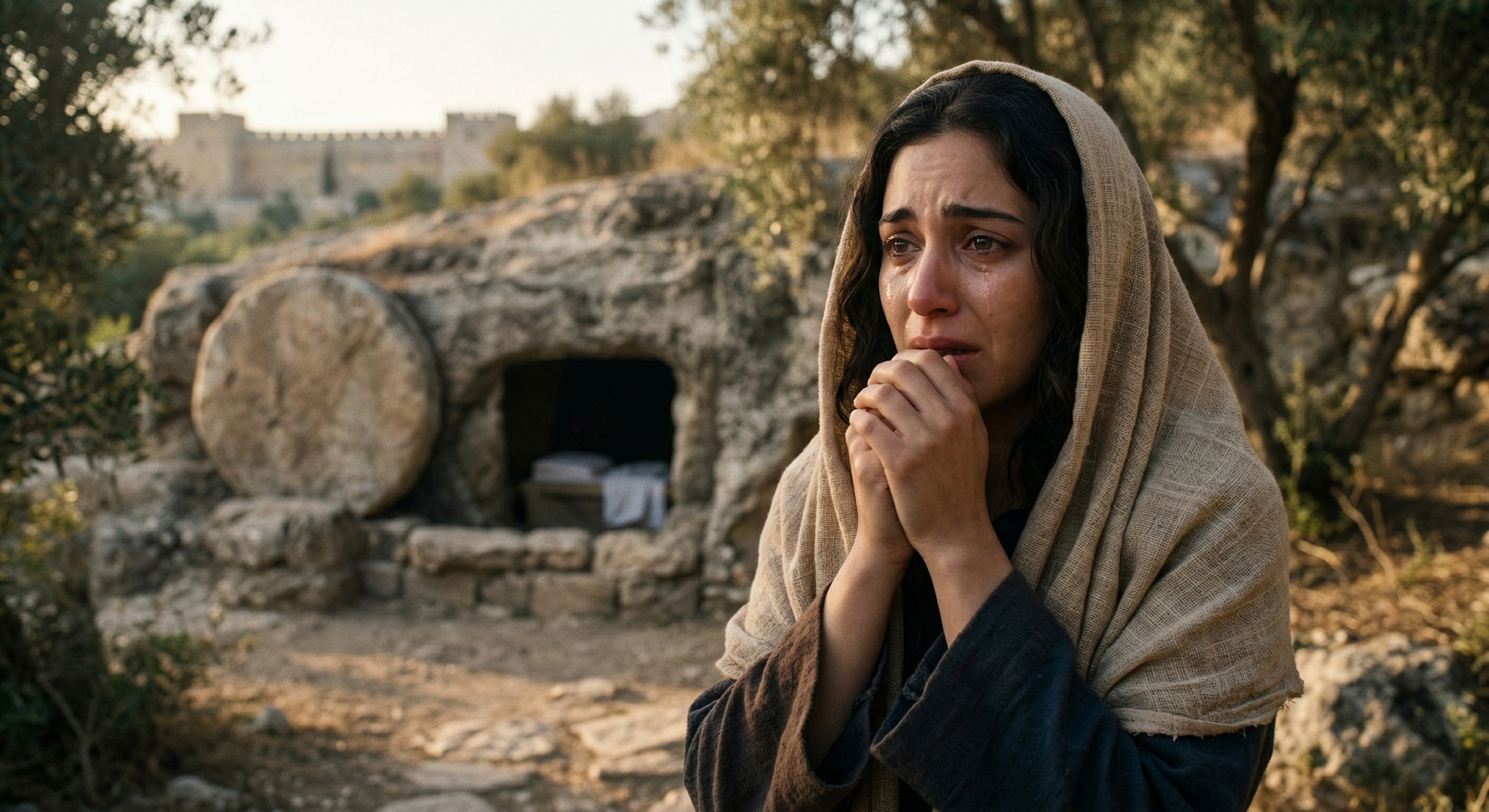
They Have Taken My Lord: And Yet He Was Standing There (John 20: 11-16)

John 20:11–16 points to the blindness that survives even at the edge of resurrection. There are moments in Scripture whose power lies not in outward spectacle, but in the quiet precision with which they expose the human heart.
John’s account is one of those moments. It is a resurrection text, certainly, but it does not begin in triumphal brightness. It begins in tears, confusion, and misrecognition. Mary Magdalene stands at the tomb weeping, and in one of the most searching ironies in all the New Testament, she speaks to the risen Christ about the absence of Christ.
That irony reaches farther than we might first imagine.
One of the reasons Easter is so often misunderstood is that modern confusion about it is not merely secular confusion; it is frequently a confused remnant of Christian memory itself. Luiz Fernando Verissimo once captured this brilliantly in a satirical piece about a child asking his parents what Easter means. The adults, though conventionally religious, lurch from one fragment of half-remembered theology to another—Jesus, resurrection, the Easter bunny, Judas, liturgical chronology—until the entire exchange collapses into absurdity. The humor works because it is uncomfortably recognizable. Religious language remains; theological coherence disappears. Something of the Christian story survives in vocabulary, but not in understanding.
And yet John 20 takes us deeper still. Here the confusion is not that of a secularized household fumbling inherited symbols. It is the confusion of those nearest to the events themselves. The signs are already there. The stone has been moved. The tomb is empty. The grave cloths have been seen. Mary herself sees angels. And still the meaning of it all remains hidden from those standing closest to it. John has already told us why: “as yet they did not understand the Scripture, that he must rise from the dead.”
That is the issue. Not the absence of evidence, but the absence of scriptural understanding. Not lack of facts, but failure of interpretation.
When reality is present, but we do not know how to read it
This is one of the most unsettling themes in the resurrection narratives: the first witnesses are not dealing with a shortage of indications, but with a shortage of rightly ordered perception. The disciples are not irreligious. They are not strangers to revelation. They belong to the covenant people, have lived in the world of Scripture, and have spent years under the direct teaching of Jesus. Yet they still prove unable, at this point, to interpret reality according to the Word of God.
That is why the problem is more serious than mere ignorance. It is a kind of blindness.
This blindness can be summarized with clear sharpness: hearts blocked to revelation, an inversion of literal and spiritual categories, and an excessive fixation on self and circumstance. Those three observations go to the heart of the matter. The disciples had a way of literalizing what should have been received spiritually and spiritualizing what Christ had spoken concretely. They wanted an immediate and visible political kingdom, but when Jesus spoke plainly about His death and resurrection, they treated those realities as though they belonged to some less definite realm. The result was that when the evidence of resurrection stood before them, they remained imprisoned within assumptions too small for it.
That diagnosis is not confined to the first century. It remains one of the permanent possibilities of fallen religious consciousness. Human beings are entirely capable of standing before the acts of God and misreading them because they interpret reality not by Scripture, but by fear, grief, habit, ideology, or emotional momentum.
Mary’s devotion is real, but it is not yet clear-sighted
Mary Magdalene is not presented as cynical, cold, or indifferent. Quite the contrary. Her grief is genuine, and her devotion to Jesus is moving. She remains when others leave. She lingers at the place of sorrow. There is loyalty in that, and tenderness too.
But the Gospel will not allow emotional sincerity to substitute for theological clarity.
Her repeated statement is revealing: “They have taken away my Lord, and I do not know where they have laid him.” That is more than lament. It is an inadvertent disclosure of how deeply she is still operating within the logic of death. The Jesus she seeks is a Jesus who can be moved, handled, relocated, and cared for. She is searching for Him as one searches for a body.
That is what makes the passage so arresting. Mary is speaking to the risen Christ about the missing corpse of Christ. She is so committed to her reading of the situation that she cannot recognize the One standing before her. Even the presence of angels fails, at first, to break the enclosure of her assumptions. The risen Lord is not absent. He is present, near, immediate. But she remains unable to reckon with a reality that exceeds her categories.
There is something here that cuts close to the bone. It is possible to love Jesus and still misunderstand Him. It is possible to speak tenderly of “my Lord” and still imagine Him under terms that diminish His glory. Devotion is not unimportant; far from it. But devotion alone does not cure theological smallness.
When we imagine that Christ can be “taken”
This is where an old Christian poet becomes unexpectedly useful. George Herbert, in The Dawning (1633), describes the human condition as one in which we may still “feel his death, but not his victory.” That is precisely the tension of John 20. Mary believes she knows what has happened. The body is gone. The Lord has been taken. The story now seems to belong to memory and grief.
But what if our settled reading of reality is wrong? What if the story does not end where our disappointment assumes it ends? What if what appears to be final loss is not final at all? What if grief, though real, is nevertheless a poor interpreter of reality? That is exactly the point. Mary is wrong, not because her grief is unreal, but because her interpretive framework is too narrow. And that same narrowing occurs repeatedly in the church.
We look at cultural instability, institutional confusion, theological compromise, moral collapse, persecution, or personal upheaval, and we begin, often without saying it aloud, to think as though Christ had somehow become vulnerable to the movements of history. We speak, in one register or another, as though “they have taken my Lord.” We say it when we panic about the church. We say it when we are overwhelmed by social disintegration. We say it when we imagine that the future of truth depends, finally, on our capacity to hold the line with sufficient energy.
But the resurrection is God’s definitive contradiction of that entire imagination.
Christ has not been taken. He has not been displaced. He is not a sacred object whose preservation depends upon our anxious efforts. He is not awaiting rescue from His people. He is the living Lord.
The subtle presumption of wanting to “care for Him”
Mary goes further. She tells the supposed gardener that if he has carried Jesus away, he should tell her where the body is, and she will take Him. The statement is full of affection, but it also contains a subtle inversion. While Jesus lived, He cared for her. Now, under the pressure of grief, she imagines that it falls to her to care for Him.
That inversion is not unique to Mary. It is one of the characteristic temptations of serious Christians. We begin to act as though Christ’s truth depended upon our management, His honor upon our agitation, His church upon our activism, His relevance upon our defense. In moments of tension or decline, we quietly assume that the burden of sustaining His cause has slipped onto our shoulders.
The resurrection restores proportion. Christ is not the one who needs preserving. He is the one who preserves His own. He is not the object of our anxious custodianship. He is the Shepherd of the sheep, the risen Lord of the church, the one before whom even death has yielded.
That does not make obedience unnecessary. It makes obedience sane. It turns our action from desperation into response.
The one word that changes everything
Then comes the turning point, and it comes with astonishing simplicity. Jesus says to her, “Mary.”
That single word carries the whole weight of revelation in the scene.
Jesus does not first lead her through an evidential argument. He does not begin with a theological lecture. He addresses her personally. And in that moment everything changes. More important than Mary’s finally identifying Jesus is that Jesus makes plain that He knows Mary. More important than our recognizing Him is His showing that He knows us.
This is deeply Johannine. Earlier in the Gospel, Jesus had spoken of the good shepherd who calls His sheep by name, and whose sheep know His voice. Now, in the garden of resurrection, that truth is enacted rather than merely stated. The Shepherd speaks, and one of His own is gathered out of grief and confusion into recognition.
This is not sentimentalism. It is theology. We do not come to know Christ merely by assembling enough pieces correctly. We know Him because He makes Himself known. We recognize Him because He has first recognized us. The initiative is His. Grace does not simply assist perception; it creates it.
From tears to worship
Mary’s response is immediate: “Rabboni!”—Master. That response matters because it shows that the resurrection does not merely restore emotional consolation. It restores rightful relation. It reorders the whole self under the authority of the living Christ.
This is where the text presses most deeply upon us. The question is not only whether we affirm that Christ rose from the dead. The question is whether we still seek Him under assumptions shaped by death. Whether our anxieties, our activism, our fears for church and culture, our exhaustion, and our habits of interpretation have left us staring into the tomb while failing to see the risen Lord standing before us.
John 20 is not merely a comforting scene for mourners, though it is surely that. It is also a rebuke to panic, to religious self-importance, and to the subtle presumption that Christ’s survival depends on us. He has not been taken. He stands. He speaks. He calls His own by name.
And when He does, theology reaches its true end. Not agitation. Not control. Not self-display. Adoration.
Mary hears her name, and the only fitting answer is the one she gives:
Rabboni.
Master.
_____________________________________________________________________
Dr. Davi Charles Gomes is the International Director of the World Reformed Fellowship, a graduate of Westminster Theological Seminary; he is a minister of the Presbyterian Church of Brazil and the former Chancellor of Mackenzie Presbyterian University, in São Paulo, Brazil. Click here for a brief bio.